
Weekly Devotional: The 18th Sunday of Ordinary Time (Year A)
On this 18th Sunday in Ordinary Time, Year A invites us to reflect on one of Jesus’ most famous miracles: the feeding of the five thousand. This event, recorded in all four Gospels, reveals significant truths about Jesus’ identity, His divine authority, and His limitless love for us.
Today, we will examine how this miracle of feeding the five thousand is rooted in Old Testament tradition, reveals the broader scope of Jesus’ mission, and provides hope and assurance for our daily lives.
A Look at the First Reading
Our first reading from Isaiah presents a vision of a divine banquet, a feast prepared by God for all people, offered freely. Isaiah proclaims, “Ho, everyone who thirsts, come to the waters… buy wine and milk without money and without price.” This imagery signifies the spiritual nourishment and eternal life that God promises through the Messiah.
This passage prepares us to understand Jesus’ miracle in the Gospel. It anticipates the ultimate messianic feast, an everlasting covenant in which God’s love is freely given, fulfilling the deepest spiritual hunger.
The Psalm
Today’s Psalm reinforces this theme: “The eyes of all look to thee, and thou givest them their food in due season. Thou openest thy hand, thou satisfiest the desire of every living thing.” This passage reminds us that God, as our gracious Provider, cares for all creation and supplies our needs in due time.
This psalm invites us to trust in God’s providence, recognizing that as He sustains all living things, He also desires to nourish and satisfy us spiritually through His divine abundance.
The Second Reading
In his Letter to the Romans, St. Paul assures us of the unbreakable love of Christ. He asks, “Who shall separate us from the love of Christ?”. He immediately answers, “Nothing in all creation can separate us from the love of God in Christ Jesus our Lord.”
This passage affirms that no suffering, persecution, or spiritual attack can sever our relationship with Christ. It proclaims victory in the midst of hardship and describes believers as “more than conquerors” through His love. Paul’s words strengthen our confidence that, regardless of life’s challenges, we remain eternally secure in God’s love.
It is important to note that Paul does not address sins in this passage, which do separate us from God. Instead, he lists circumstances beyond our control, such as persecution, opposition, and distress, which the apostles also experienced. These situations do not separate us from God’s grace, even if, externally, they may appear as abandonment or forsakenness.
This reality reminds us of the long-standing tradition of the Church regarding God’s continuous providential care. As the early Church Father Origen of Alexandria wrote in his work Against Celsus (4:7):
“…there never was a time when God did not wish to make men live righteous lives; but He continually evinced His care for the improvement of the rational animal, by affording him occasions for the exercise of virtue. For in every generation the wisdom of God, passing into those souls which it ascertains to be holy, converts them into friends and prophets of God.”
Origen’s insight beautifully mirrors Paul’s message: God has never abandoned His creation. In every age, He provides the necessary grace and opportunity for holiness, constantly inviting us into His friendship.
Therefore, even when we are caught in the midst of intense spiritual warfare, we can rest in the certainty that these trials cannot sever us from our Creator. As Paul continues:
“For I am sure that neither death, nor life, nor angels, nor principalities, nor
things present, nor things to come, nor powers, nor height, nor depth, nor
anything else in all creation, will be able to separate us from the love of God
in Christ Jesus our Lord.” (Romans 8:38-39)
Neither death, nor life, nor any other force in creation can separate us from Christ. Such adversities may tempt or attack us and may even threaten our mortal bodies. As Jesus instructed the Apostles: “Don’t fear the one who can destroy the body,” but “…in all these things we are more than conquerors through him who loved us.” (Romans 8:37)
The Gospel
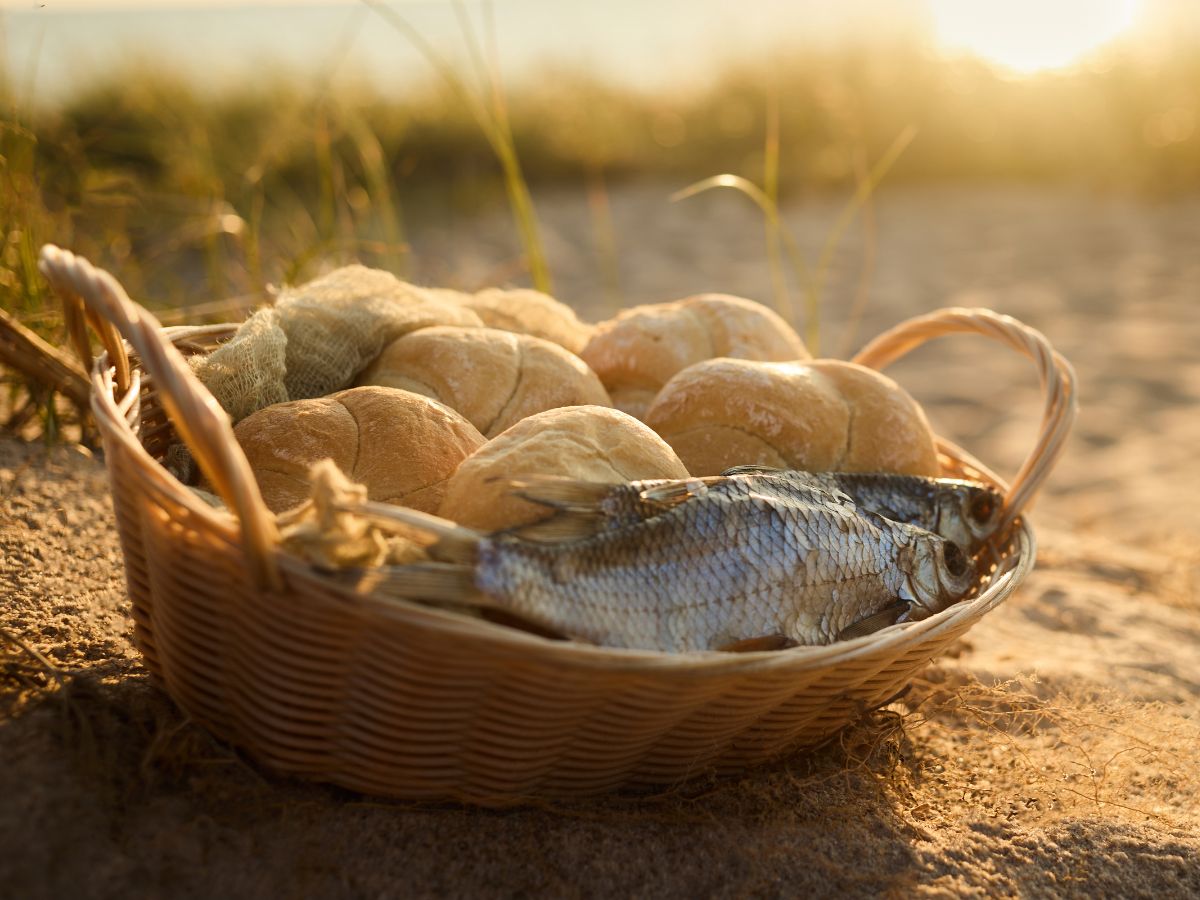
The Gospel of Matthew recounts Jesus’ miraculous feeding of the five thousand with just five loaves and two fish. Despite the small amount, Jesus blesses, breaks, and distributes the food, and everyone is satisfied, with twelve baskets of leftovers remaining.
This miracle is extraordinary not only because of the multiplication of bread but also due to its deep connection to Old Testament traditions. It recalls Elisha’s miracle in 2 Kings 4, where a small amount of bread feeds a hundred people.
Jesus, as the new Elisha, surpasses this by feeding over five thousand with just a handful of bread. His power transcends the Old Testament, revealing His divine authority and His mission as the true bread of life.
We continue to witness this multiplication today during the Eucharist.
Connecting the Readings
Together, these readings form a beautiful mosaic, revealing Jesus’ identity and mission.
Isaiah’s vision of the messianic banquet prepares us for Christ’s miraculous feeding. It offers a foretaste of the heavenly feast to come: an invitation to partake in eternal life. The Psalm underscores God’s ongoing provision, and Paul’s Letter to the Romans assures us that no suffering or spiritual enemy can separate us from the love of Christ.
The miracle of the feeding of the five thousand is not only about physical sustenance. It reveals Jesus as the Bread of Life: the One who satisfies our deepest hunger and welcomes us into the everlasting covenant of His love. At this divine banquet, grace is offered freely, and all are welcome.
Application to Our Daily Lives
As we reflect on these readings, let us trust in God’s faithful care, remembering that just as He provides for the birds and the lilies, He will also tend to our needs—both spiritual and material. In moments of hardship or suffering, may we hold fast to the truth that nothing, no trial or spiritual struggle, can separate us from His steadfast love.
This assurance calls us to lean on His grace even when life feels overwhelming, trusting that in Christ, we are more than conquerors. Each time we participate in the Eucharist, we are reminded that Jesus is the true Bread of Life, nourishing our souls and reaffirming His everlasting covenant with us.
Recognizing the Eucharist as this ultimate source of daily strength gently challenges us to examine our own hearts. It invites us to ask ourselves: How can I more intentionally participate in this divine feast? How do I allow it to truly nourish my daily living?
When we allow ourselves to be filled by Him, we are also equipped to give. We are called to reflect on how we might share the small blessings entrusted to us: our time, our gifts, our resources, so that God’s grace may multiply through us in service to others.
Key Takeaways
- The divine banquet in Isaiah and the Gospel multiplication demonstrate that God’s life-giving grace is infinite, nourishing, and given entirely without cost.
- St. Paul establishes that external hardships, earthly trials, and spiritual warfare are completely powerless against the bond of Christ’s love.
- By expanding the scope of the miracle beyond the signs of Elisha, Jesus definitively manifests His divine authority and identity as the true Bread of Life.
- The Eucharist stands as the perpetual renewal of our covenant, feeding our deep spiritual longings and urging us to share our small provisions so God can multiply them.
Final Thoughts
The feeding of the five thousand is more than a miracle of abundance. It is a profound sign of Jesus’ divine mission and His love for each of us. In Him, we find true nourishment, lasting assurance, and the promise of victory.
As we go forth this week, let us trust in God’s provision, embrace His love in every circumstance, and open our hearts to the divine feast offered to us in the Eucharist.
May we carry these truths in our hearts, confident that in Christ, we are eternally loved, nourished, and victorious.
Pax et bonum,
Michalina
I love diving into the Word with you! If you prefer to listen rather than read, I’ve put together a video version of this reflection to help you prep for Mass. You can click here to open it on YouTube, or watch it directly below.
Looking for more inspiration beyond the liturgy? Explore the main site for tips on faith, homemaking, and intentional living.