
Weekly Devotional: The 19th Sunday of Ordinary Time (Year A)
This week’s Scripture readings invite us into a deeper encounter with Jesus’ divine power and invite us to consider our own response of faith. In the Gospel, we witness Jesus walking on water, a miracle that profoundly reveals His divinity. The Old Testament reading offers us Elijah’s encounter with God, not in noise or spectacle, but in the quiet stillness. If you’re looking to step away from the noise and dive deeper into this weekend’s liturgy, I hope this look at faith in the storm serves as a restful space to discover how these passages gently call us out of fear and into true, transformative worship.
A Look at the First Reading
Elijah, fleeing from Queen Jezebel’s threats, seeks refuge on Mount Sinai, the mountain where Moses encountered God. There, the Lord reveals Himself not in the wind, earthquake, or fire, but in a gentle whisper. Elijah’s experience reminds us that God’s presence often comes quietly, inviting us to cultivate a receptive heart and attentive silence.
It is in the stillness that Elijah meets the Lord, showing us that divine encounters are often found in gentle whispers rather than dramatic signs.
The Psalm
The Responsorial Psalm gives voice to our longing for God’s salvation: “Lord, grant us your salvation; let your face shine on us, that we may be saved.” It reminds us that God’s salvation is near for those who fear Him, meaning those who stand in awe of His holiness.
Reverence and awe are not signs of weakness, but expressions of our recognition of God’s immense power and love. When we respond in worship (whether through prayer or quiet reverence) we join all those who acknowledge God’s majesty and grace.
The Second Reading
In his letter to the Romans, St. Paul expresses deep sorrow for his fellow Israelites who have not accepted Jesus as the Messiah. Despite his mission to the Gentiles, Paul’s love for his people remains strong. He highlights the privileges given to Israel: the sonship, the covenants, the law, the worship, and the promises, culminating in the gift of Christ, who comes from Israel according to the flesh.
This passage reminds us of the enduring importance of our spiritual heritage and reminds us that God’s promises to His people are rooted in love and faithfulness.
The Gospel
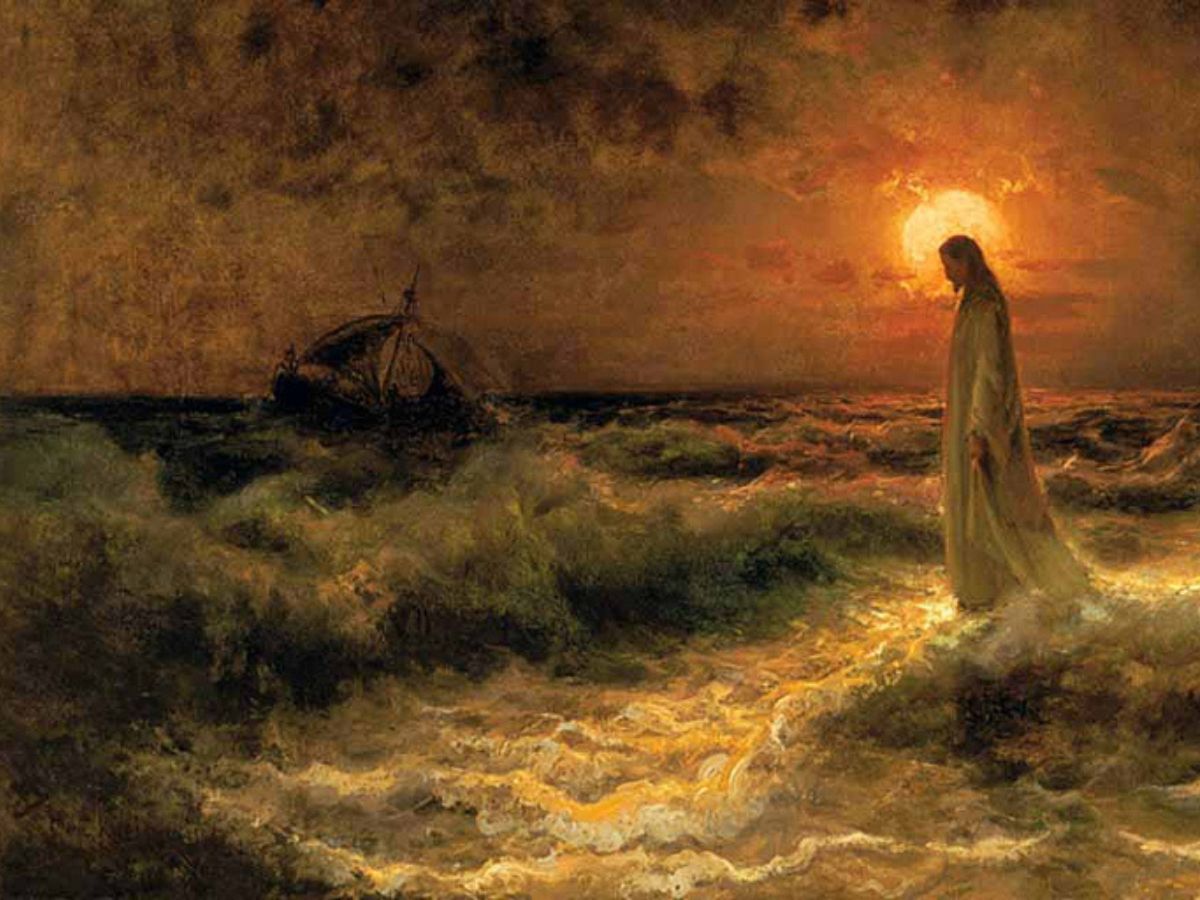
The Gospel of Matthew presents Jesus walking on the sea, an awe-inspiring act that reveals His divine authority over nature. The disciples, initially terrified, mistake Him for a ghost, but Jesus reassures them, “Take heart, I am; do not be afraid.”
To truly unpack the deep theological layers behind Jesus using the phrase “I am,” I highly recommend Dr. Brant Pitre’s fantastic book, The Case for Jesus. One specific insight from his chapter on Jesus’ divinity completely changed how I look at this passage. He explains:
“Notice two things here. First, in both the Hebrew and the Greek versions of this passage, “I am” (Hebrew ‘ehyeh’; Greek egō eimi) is a name. It is another name for “the LORD” (Hebrew YHWH), the God of the universe. Second, and equally important, this name reveals something about the God of Moses: he is eternal. He has no beginning; he has no end; he simply “is.” Indeed, the sacred name YHWH can be translated as “He who Is.” This is the God who is appearing to Moses and speaking to him from the miraculous bush that burns but is not consumed.
Once this Old Testament background is clear, we can go back to Jesus’ words to the disciples in the boat and interpret them in the context of the miracle he is performing. In light of Jesus’ miraculous display of power over the wind and sea, when he says to the disciples, “I am (Greek egō eimi); do not be afraid,” he is not just saying “It’s me.” He is revealing his divine identity to them. Just as the LORD revealed his divine name to Moses in the context of his display of power over creation in the burning bush, so too Jesus reveals his divine name to the disciples in the context of his display of power over creation when he walks on water.
[…] In a first-century Jewish context, Jesus’ act of walking on the water is nothing less than a theophany—an appearance of God—the same God who appeared to Moses on Sinai. That is why Jesus refers to himself by the mysterious expression ”I am.” Because he is revealing his divine identity as the LORD come in person.
[…], the Gospel of Matthew contains its own unique clue that Jesus is revealing his divine identity. For Matthew also tells us how Simon Peter and the disciples react to seeing Jesus walking on the water (Matthew 14:28-33). Note well that the disciples’ response to the wonder they have just witnessed is to fall down and worship Jesus. It is true that the Greek word for “worship” (proskyneō) can be used to refer either to homage given to human beings (such as kings) or the worship given to the one God alone. In any given case, the meaning depends on the context. However, […] in the Gospel of Matthew, the word “worship” (Greek proskyneō) is used “only in the sense of genuine worship of Jesus,” the kind of Jewish worship ordinarily given only to “the one God.” In other words, the disciples recognize that Jesus has just manifested divine power over the sea, and, as a result, they worship him as divine.
[…] “What matters is not that Jesus has done the seemingly impossible but that he has performed actions which the Old Testament associates with YHWH alone.”
In light of this, Peter’s bold request to walk on water demonstrates his desire to share in Jesus’ power, recognizing that if Christ is truly the “I Am” who commands the sea, He can enable His followers to overcome the chaos as well.
However, when Peter takes his eyes off Jesus and notices the strength of the storm, he begins to sink, illustrating how quickly human doubt can overshadow divine faith. Jesus’ immediate response, stretching out His hand and catching him while asking, “O man of little faith, why did you doubt?” is not a rejection of Peter, but a gentle reminder that our security rests entirely on His steady, divine presence rather than our own strength. It calls us to trust fully in Him amid life’s trials.
Connecting the Readings
Both the Old and New Testament readings focus on divine encounters that transform fear into worship. Elijah’s encounter with God and Jesus walking on water demonstrate that God’s power often reveals itself through quiet majesty and authority. The disciples’ worship of Jesus as “truly the Son of God” echoes Elijah’s awe before God’s presence. These passages remind us that God’s divine presence is not absent in chaos; rather, He uses these moments to cultivate a deep, unshakable faith in the storm that challenges and transforms us.
Application to Our Daily Lives
In our daily lives, we all face storms, whether personal struggles, fears, or uncertainty. These Scripture passages encourage us to look for God’s presence in quiet moments. When we feel overwhelmed, we should remember that Jesus is walking with us, giving us comfort and strength.
There are times when we find ourselves weary and surrounded by the chaos of daily life. In such moments, it is natural to feel overwhelmed or anxious. Like Peter, we may begin with courage, yet when we focus on the winds and waves around us, our attention shifts away from Christ.
Each of us knows what it is to be unsettled by life’s storms, to lose sight of the One who holds all things in His hands. Yet, Scripture assures us: ‘And immediately Jesus stretched forth his hand and caught him.’ The Lord is always ready to reach out, to steady us, and to remind us, ‘Take courage, I am with you; do not be afraid.’
When our faith falters, and our focus drifts, Jesus remains present. He does not abandon us to the depths, but reaches into the heart of our struggles, offering His hand to lift us. If we find ourselves amid storms or uncertainty, let us turn our gaze once more to Him.
Recognizing Jesus as our anchor gently challenges us to examine our own hearts. How can I more intentionally look for His presence in the quiet moments? How do I allow His voice to calm my daily anxieties?
In prayer, we can stretch out our hand, trusting that He will hold us fast and guide us safely through. When we allow ourselves to be anchored by Him, we are also equipped to serve. Cultivating reverence and trust in God’s divine presence transforms our fear into worship and our doubts into confidence.
Key Takeaways
- The Gentle Whisper: God often reveals His presence and power in quiet, subtle ways rather than overwhelming spectacles.
- True Reverence: Awe and holy fear are appropriate responses to God’s immense majesty, reflecting a deep recognition of His love.
- Faith in the Storm: True belief requires keeping our eyes fixed on Jesus, even when external chaos threatens to distract us.
- The Reaching Hand: Doubt may cause us to sink, but Jesus is instantly ready to stretch out His hand and rescue us.
- The Divine “I Am”: Walking on the water manifests Jesus’ ultimate divine authority over creation as the eternal Son of God.
- Worship in Chaos: Recognizing Christ’s true identity moves us from paralyzing fear into profound, adoring worship.
- Rooted Promises: Our salvation history and spiritual heritage are fully secure in God’s unwavering covenantal faithfulness.
Final Thoughts
This week’s readings challenge us to see beyond the surface, to recognize the divine in the stillness, to trust Jesus amid the storms, and to respond with awe and worship.
God’s power is not always loud or obvious; often, it’s in the gentle whisper that we find His presence.
Let us cultivate hearts receptive to His divine voice, trusting fully in His plan and His love.
As we navigate our own trials, cultivating this faith in the storm reminds us that Jesus walks on water, He calms the waves, and He remains with us always: Emmanuel, which means “God is with us”, here and now.
Pax et bonum,
Michalina
I love diving into the Word with you! If you prefer to listen rather than read, I’ve put together a video version of this reflection to help you prep for Mass. You can click here to open it on YouTube, or watch it directly below.
Looking for more inspiration beyond the liturgy? Explore the main site for tips on faith, homemaking, and intentional living.