

Have you ever wondered why chocolate eggs dominate Easter celebrations? While this tradition delights children, shouldn’t we prioritize teaching the true meaning of Easter from an early age? My aim isn’t to criticize, but to encourage us to celebrate Easter in a way that is faithful to its spiritual significance. I want us to explore how we reclaim the true meaning of Easter.
And for sure, I do not want to exclude the celebrant, who in this case is Jesus, our Savior.
I feel so grateful for my parents, who were my first teachers in faith. Some of my fondest childhood memories are of truly and faithfully celebrating these ancient events as a family.
To set the scene, let’s take a brief journey together! We’ll explore the commercialization of Easter, the origins of chocolate eggs, and how we can reclaim Paschal celebrations.
This brings us to the question: why do we use the word ‘Easter’?
Every year, as Easter approaches, discussions between secular and religious Internet “experts” arise. You can find a multitude of resources on both sides, which can be overwhelming, and often it is. I love Dr. Brant Pitre’s reminder: “It’s OK to not know the answer, but it’s not OK to not seek it”.
Inspired by that, I set out on a quest to find answers to my Easter questions. I scoured the Internet for a few hours as preparation for writing this post and to build confidence in engaging in conversations with non-believers if the opportunity arises.
Let’s start from the beginning…
Did you know that the word “Easter” is used to name the Resurrection Sunday only in English and German-speaking countries? Huh…
You might wonder, why? And the next question follows: how do other countries around the world refer to this important day for Christians, then?
Now, what about all those chocolate eggs and bunnies?
Some scholars think German migrants may have brought the custom with them to the United States. History.com explains:
According to some sources, the Easter bunny first arrived in America in the 1700s with German immigrants who settled in Pennsylvania and transported their tradition of an egg-laying hare called “Osterhase” or “Oschter Haws.” Their children made nests in which this creature could lay its colored eggs. Eventually, the custom spread across the U.S., and the fabled rabbit’s Easter morning deliveries expanded to include chocolate and other types of candy and gifts, while decorated baskets replaced nests. Additionally, children often left out carrots for the bunny in case he got hungry from all his hopping.
There’s also questionable symbolism attached to eggs. They’re connected to the goddess Ishtar. A popular Internet graphic claims to explain the “true” meaning of Easter.
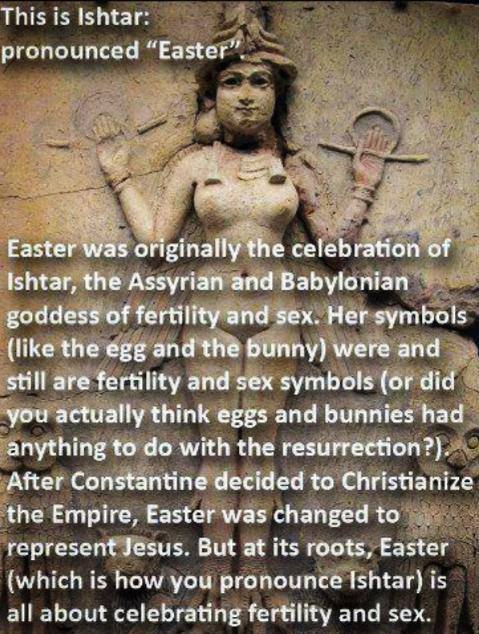
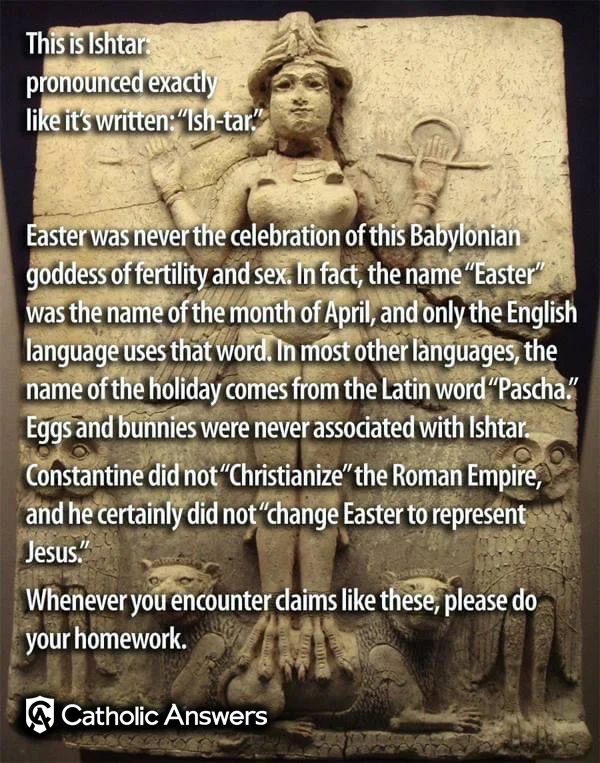
From what I’ve found (and I highly encourage you to explore, too!), I’ve discovered that the word “easter” is of Old English origin and has nothing to do with the Assyrian/Mesopotamian goddess Ishtar. England and Mesopotamia are worlds apart, and even though the names sound alike, they aren’t related.
So, “Easter” simply means “east” in English as well as in German, as for the direction of the rising sun.
I have to admit, I love learning about where words come from—etymology is one of my passions!
So, what does Pascha mean for Christians?
Now, if we look around the world, the Christian celebration of the Resurrection of Jesus is called Pascha, or some of its offshoots. This is where we find the true heart of our Easter joy.
Pascha means Passover. When we celebrate Pascha, we commemorate the sacrifice of Jesus on the Cross, our “paschal lamb.” You may recall John the Baptist, seeing Jesus coming toward him, crying out, “Behold, the Lamb of God, who takes away the sin of the world!” (John 1:29).
Did you know that the way Christians celebrate Pascha is sometimes a topic of ‘conversation’ among our Jewish friends? In our own family, my husband and I have started ending our Lenten journey with a simple ‘last supper’ meal, and it’s become a meaningful tradition for us.
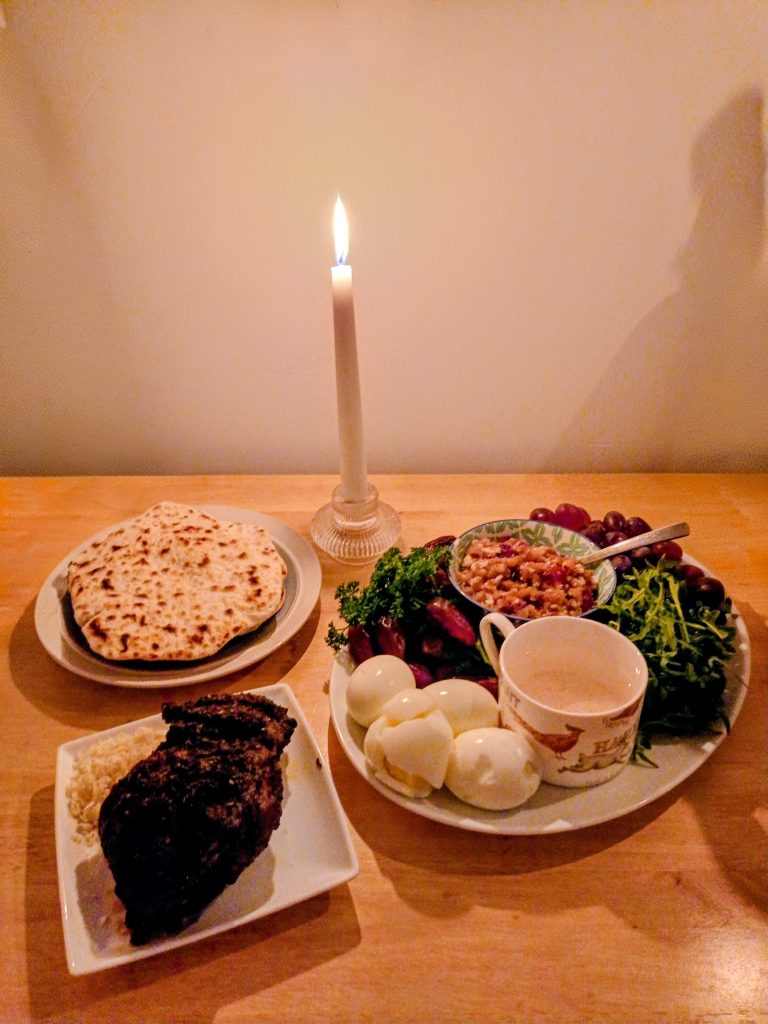
In the Old Testament, the Jewish Passover memorial celebrated God’s deliverance of Israel from Egyptian slavery. During this momentous night, every firstborn son in Egypt passed except those in Israelite families where a lamb without blemish was slain and eaten as a sacrifice. Then Moses led Israel out of Egypt to Mount Sinai, where the Law was given, and the covenant was sealed between God and His people.
So, in the New Testament, in the person of Jesus (the Sacrificial Lamb), the New Covenant is established, and God’s law is now written on people’s hearts rather than on stone.
The story of Exodus is one of my favorite stories in the Bible, and it quickly became a passion of mine to study it, especially in the context of the Last Supper and Jesus’ death and resurrection.
How can we reclaim the true meaning of Easter?
Easter is the high point of the liturgical calendar. It’s not just another Holy Day, it’s the celebration of the Paschal Mystery: Jesus’ suffering, death, and glorious Resurrection.
Rediscovering Easter’s true meaning requires shifting our focus from commercial traditions toward its spiritual heart. My core argument is that this shift transforms Easter from a surface celebration into a profound, personal journey rooted in faith.
Now that we know the nitty-gritty, we can explore ways to help us reclaim the true meaning of Easter celebrations.
Here are ideas to help your family focus on Easter’s core instead of its seasonal distractions.
1. Walk Through Holy Week with Mindfulness
- Carry a small palm on Palm Sunday as a reminder of Jesus’ kingship and humility.
- Participate actively on Holy Thursday—consider washing family members’ feet or doing a small act of service.
- Spend time in silence before the Crucifix on Good Friday, contemplating Christ’s love.
- Light a candle and pray with the Church on Holy Saturday.
- Rejoice on Easter—sing, celebrate, and let the “Alleluia” be a prayer of hope.
2. Engage with Scripture Gently and Reflectively
- Read the Passion and Resurrection stories slowly, in prayer.
- Pause between passages to meditate on the text, thinking about how it applies to you personally.
- Keep a journal of insights, feelings, or questions.
- Reflect on key verses like Romans 6:4 or 1 Corinthians 15:20‑22 to deepen your hope.
3. Receive the Sacraments with Intention
- Use this season for confession—release sins and embrace renewal.
- Participate in the Eucharist, especially on Easter, to receive nourishment and unity with Christ.
4. Practice Daily Reminders of Resurrection
- End each day with the Examen—notice moments of grace, love, and peace.
- Meditate on the Stations of the Cross, visualizing the journey from death to life.
- Perform acts of kindness—volunteering, helping, or simple gestures of love—as signs of the risen Christ.
5. Share and Reflect with Family and Community
- Gather after the Easter Vigil for a simple reflection on the meaning of Resurrection.
- Invite loved ones into prayer, stories, and acts of service.
- Share why Easter is meaningful to you, beyond the festivities.
6. Grow in Knowledge and Faith
- Read trusted resources* such as the Catechism of the Catholic Church, spiritual reflections, or the writings of saints.
- Let these teachings inspire you to live out hope, love, and freedom from sin each day.
* Here’s a graphic from catholic.com they allow to share as a response to the one I’ve mentioned above:
7. Live the Resurrection Daily
- Make a conscious choice to walk in hope and forgiveness every day.
- Rejoice in the victory of Christ—letting it transform your attitude and actions.
- Remember: the Resurrection is not just a past event but a present invitation to new life.
8. A Simple Daily Easter Prayer (for the Whole Season)
Lord Jesus, risen King,
You entered the grave to free us from the death of our sins.
Grant that I may rise each day with You,
Living in love, hope, and charity.
Teach me to bear my cross with humility
and to proclaim your joy to the world.
Amen.
Try praying these words each morning—maybe after Mass or as you jot down a thought in your Easter journal. Let this prayer shape your day with hope throughout the season.
Final Thoughts
When these elements come together, Easter becomes more than a date on the calendar—it transforms into a daily, living experience of the risen Christ. By intentionally focusing on its core meaning and spiritual depth, you can reclaim Easter, letting its hope and joy shape your life all year long.
I hope that these simple, practical ideas helped you discover new ways to reclaim the true meaning of this Easter season.
Blessings to you and your family as you journey toward the empty tomb!,
Michalina